
Wearable Sleep Trackers Market Grows as AI Analytics Push Consumer Devices Toward Clinical-Grade Monitoring


As per SNS Insider, the Global Wearable Sleep Trackers Market is projected to reach USD 48.60 billion by 2035, growing at a 11.20% CAGR, while the U.S. market is projected to reach USD 18.59 billion, advancing at 10.90% CAGR, as multi-sensor fusion and machine learning extend sleep monitoring into clinically adjacent, preventive health applications.
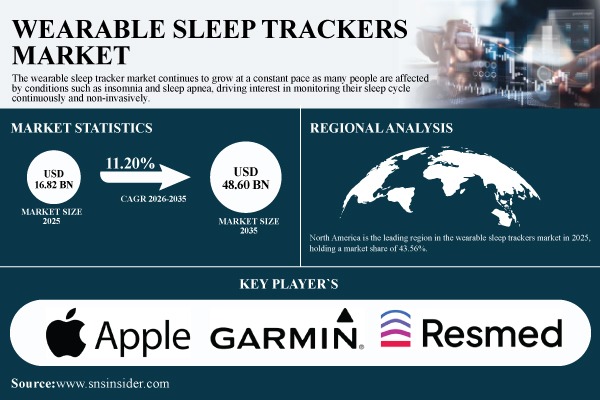
Austin, Texas, Sept. 19, 2026 (GLOBE NEWSWIRE) — The global Wearable Sleep Trackers Market was valued at USD 16.82 billion in 2025 and is expected to reach USD 48.60 billion by 2035, growing at a CAGR of 11.20% during 2026–2035. The growth in the market will be driven by the increase in the prevalence of insomnia and sleep apnea, along with increasing consumer interest in continuous non-invasive sleep monitoring. The market is also growing due to an increase in the usage of photoplethysmography, skin-temperature detection and sleep-stage analysis using machine learning. Sleep quality can now be measured using watches, bands, rings, and even earbuds.
Download the Wearable Sleep Trackers Market Sample Report: https://www.snsinsider.com/sample-request/11050
The U.S. Wearable Sleep Trackers Market was valued at USD 6.43 billion in 2025 and is projected to reach USD 18.59 billion by 2035, growing at a CAGR of 10.90% during 2026–2035. The market expansion is primarily fueled by the increase in the number of people suffering from insomnia and sleep apnea, the penetration rate of consumer electronics, and the already existing routes for reimbursing sleep diagnostics. Approval of the clinical adjacent applications of wearables by the FDA and their widespread adoption for sleep cycle monitoring, breath monitoring, and recovery are additional factors that contribute to the growth of domestic demand.
Why this Market is Gaining Attention in 2026
AI-Driven Sleep Analytics and Clinical-Adjacent Monitoring Are Expanding the Role of Consumer Wearables
Sleep-monitoring wearables are becoming more pertinent due to advancements in sensing technology through miniaturization, reduced power needs, and machine learning. The contemporary sensors incorporate information from heart rate variability, SpO2, skin temperature, and breathing to monitor sleep stages, disturbances, and recovery. Integration of the sleep-monitoring technologies with telemedicine and behavioral healthcare, as well as regulation approval of certain features, such as sleep apnea detection, is making sleep monitoring move towards a wider range of preventive medicine uses.
Commercial Findings from the Wearable Sleep Trackers Market
Watches Dominated While Bands Are the Fastest-Growing Product Segment: Watches accounted for 78.50% of the Wearable Sleep Trackers Market in 2025, due to their capacity to integrate features such as sleep staging, HRV, SpO2 measurement, and monitoring daytime activity in one product. Bands are projected to grow at the fastest CAGR of 13.80% during 2026–2035, due to their low cost, small size, and longer battery life.
Insomnia Dominated Applications While Sleep Apnea is Growing Fastest: Insomnia was expected to account for 47.20% share of the market in 2025 due to the high prevalence of sleep onset disorders and sleep maintenance disorders along with increased awareness about the health complications linked to lack of sleep. Sleep Apnea was anticipated to be the fastest growing type of sleep disorder with a CAGR of 12.60% through 2035 owing to the algorithm clearance and increased availability of SpO2 and respiratory sensors for diagnosing obstructive sleep apnea.
North America Led the Market While Asia Pacific is Expected to Grow Fastest: In 2025, North America held the largest share at 43.56% of the worldwide Wearable Sleep Trackers Market owing to its high consumer buying capacity, early adoption of connected health technology, advanced healthcare system infrastructure, and telemedicine integration with wearable devices. Asia Pacific is expected to exhibit the highest CAGR of 13.10% from 2026 to 2035 due to increasing health concerns related to sleep disorders, growing middle-class consumer spending power, and availability of affordable local wearables.
Do you have any specific queries or need any customized research on Wearable Sleep Trackers Market? Schedule a Call with Our Analyst Team: https://www.snsinsider.com/enquiry/11050
Who Should be Watching the Wearable Sleep Trackers Market?
The market is increasingly relevant across the consumer health, digital wellness and connected-care ecosystem, including:
Wearable manufacturers → smartwatch brands → smart-ring developers → sensor manufacturers → telehealth providers → behavioral-health platforms → sleep clinics → digital health companies → healthcare providers → remote-monitoring technology companies
For wearable tech providers, commercial possibilities abound in watches, bands, rings, earbuds, and artificial intelligence–based sleep analytics and coaching subscriptions. For healthcare and wellness providers, usage is increasingly driven by the quality of sensors, sleep comfort, battery life, clinical adjacencies, data interoperability, and the integration of sleep data into remote monitoring and preventative health care workflows.
AI Integration and Clinical Feature Development Shape the 2026 Market
Investments in artificial intelligence for sleep-stage analysis, multi-sensor fusion, and monitoring close to clinical applications are revolutionizing the wearables industry in terms of sleep monitoring technologies. The development of such products is more concerned with enhanced sleep-staging, extended battery life, and broader functionality than just overall well-being.
- In 2026, Fitbit introduced major sleep-tracking improvements, including a reported 15% increase in sleep-staging accuracy for Public Preview users and more advanced AI-powered personalized sleep guidance.
- In 2026, Ultrahuman launched Ring PRO with up to 15 days of battery life and introduced Jade, an AI system designed to provide real-time interpretation of health data.
Market Challenge: Data Accuracy Concerns and Privacy Requirements Constrain Expansion
Sleep monitors that people wear has not yet achieved the required level of precision when compared to the clinical procedure called polysomnography, especially regarding sleep stage transition and respiratory disorders. This fact makes it impossible to use consumer wearable devices as an alternative to proper clinical diagnosis for those conditions, which need verification through laboratory tests and analysis.
Data protection laws have become stricter as wearable devices are capturing sensitive health data continuously. Following GDPR will lead to extra expenses and even monthly subscription charges in case of more advanced analytical tools.
Buy the Wearable Sleep Trackers Market Report with Competitive Analysis at a 20% Discount: https://www.snsinsider.com/checkout/11050
Key Competitors in the Market
Companies covered in the Wearable Sleep Trackers Market research include Apple Inc., Fitbit LLC (A Google Company), Garmin Ltd., Ōura Health Oy, Koninklijke Philips N.V., ResMed Inc., Huawei Device Co., Ltd., Xiaomi Corporation, Samsung Electronics Co., Ltd., Withings SA, Zepp Health Corporation Ltd., Polar Electro Oy, Suunto Oy, Whoop, Inc., Beurer GmbH, RingConn Inc., Ultrahuman Healthcare Pvt. Ltd., Mobvoi Inc., Biostrap Labs, Inc., and Fireboltt Innovations Pvt. Ltd.
CONTACT: About Us: SNS Insider is one of the leading market research and consulting agencies that dominates the market research industry globally. Our company's aim is to give clients the knowledge they require in order to function in changing circumstances. In order to give you current, accurate market data, consumer insights, and opinions so that you can make decisions with confidence, we employ a variety of techniques, including surveys, video talks, and focus groups around the world. Contact Us: Rohan Jadhav - Principal Consultant Phone: +1-315-961-9094 (US) Email: info@snsinsider.com
 Disclaimer: The above press release comes to you under an arrangement with GlobeNewswire. IndiaEveningPost.com takes no editorial responsibility for the same.