
Smart Adaptive Elevator Algorithm Market Size to Hit USD 19.71 Billion by 2035 | Research by SNS Insider


The U.S. Smart Adaptive Elevator Algorithm Market is projected to grow from USD 1.34 Billion in 2025 to USD 3.07 Billion by 2033, at a CAGR of 10.91%. The increasing demand for modernization of existing elevators in commercial and residential buildings is propelling the market. An improved level of customer satisfaction, safety, and efficiency further boost the case for adoption. To conclude, urbanization and smart cities play an important role in the expansion of the global market.
Austin, May 11, 2026 (GLOBE NEWSWIRE) — Smart Adaptive Elevator Algorithm Market Size & Growth Outlook:
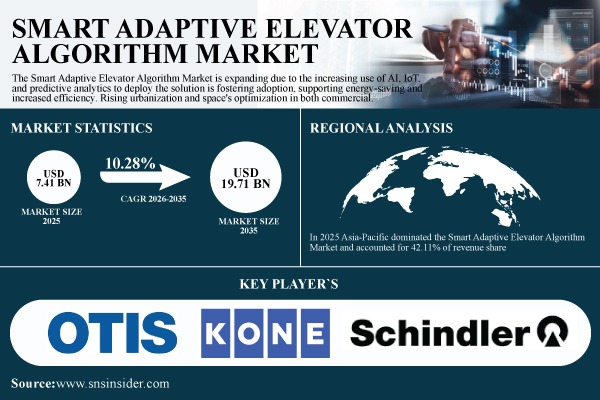
According to the SNS Insider, “The Smart Adaptive Elevator Algorithm Market was valued at USD 7.41 Billion in 2025 and is expected to reach USD 19.71 Billion by 2035, growing at a CAGR 10.28% during 2026-2035.”
Rising Urbanization to Augment Market Growth Globally
The market of smart adaptive elevator algorithm is predominantly fueled by urbanization and construction of high-rise buildings, which require effective passenger movement. The combination of AI and machine learning ensures that passengers move without any waiting time. The energy-efficient algorithms lower the cost of operations and complement green objectives. Investment in the replacement of old elevators in commercial and residential areas is contributing significantly to the market’s growth.
Smart Adaptive Elevator Algorithm Market Size and Growth:
- Market Size in 2025: 7.41 Billion
- Market Size by 2035: 19.71 Billion
- CAGR: 10.28% during 2026–2035
- Base Year: 2025
- Forecast Period: 2026–2035
- Historical Data: 2022–2024
Get a Sample Report of Smart Adaptive Elevator Algorithm Market Forecast @ https://www.snsinsider.com/sample-request/9744
Leading Market Players with their Product Listed in this Report are:
- Otis Elevator Company
- KONE Corporation
- Schindler Group
- Thyssenkrupp AG
- Mitsubishi Electric Corporation
- Hitachi Ltd.
- Fujitec Co. Ltd.
- Hyundai Elevator Co. Ltd.
- Toshiba Elevator and Building Systems Corporation
- Johnson Lifts Pvt. Ltd.
- Sigma Elevator Company
- Orona Group
- Express Lifts Ltd.
- Shanghai Mechanical & Electrical Industry Co. Ltd. (SMEC)
- Sicher Elevator Co. Ltd.
- Avire (Halma plc)
- Motion Control Engineering (MCE)
- Wittur Group
- Dover Elevator (now part of Thyssenkrupp)
- Kleemann Hellas SA
Smart Adaptive Elevator Algorithm Market Report Scope:
| Report Attributes | Details |
| Base Year | 2025 |
| Forecast Period | 2026-2035 |
| Historical Data | 2022-2024 |
| Report Scope & Coverage | Market Size, Segments Analysis, Competitive Landscape, Regional Analysis, DROC & SWOT Analysis, Forecast Outlook |
| Key Segmentation | • By Component (Software, Hardware, Services) • By Application (Commercial Buildings, Residential Buildings, Industrial Facilities, Hospitals, Airports, and Others) • By Deployment Mode (On-Premises, Cloud-Based) • By End-User (Real Estate Developers, Facility Management Companies, Transportation Hubs, and Others) |
Purchase Single User PDF of Smart Adaptive Elevator Algorithm Market Report (20% Discount) @ https://www.snsinsider.com/checkout/9744
Key Segmentation Analysis:
By Deployment
On-premises solutions remain the dominant deployment mode, accounting for the largest market share of 67.32% in 2025 due to their proven reliability, enhanced control over system operations, and widespread adoption across deployed elevator systems. Cloud-based deployment is expected to grow at the fastest pace, at a CAGR of 10.61% owing to increasing demand for remote monitoring, real-time data analytics, seamless IoT integration, predictive maintenance capabilities, and rising adoption of smart building solutions.
By component
Software remains the dominant component segment, accounting for the largest market share of 46.32% in 2025 due to its extensive use in elevator control systems and operational management functions. Hardware is expected to grow at the fastest pace, at a CAGR of 10.80% owing to the rising demand for advanced sensors, smart sensing devices, improved system integration capabilities, and increasing adoption of energy-efficient and smart elevator systems.
By Application
Commercial buildings remain the dominant application segment, accounting for around 35.23% market share in 2025 due to the rising number of high-rise office towers, commercial infrastructure projects, and increasing demand for efficient passenger flow management systems. Residential buildings are expected to grow at the fastest pace, at a CAGR of 11.05% owing to rapid urbanization, growing adoption of high-rise apartments, increasing retrofitting activities, and rising demand for smart, secure, and energy-efficient elevator systems.
By End-User
By end-user, real estate developers dominated the market, accounting for 45.63% share in 2025 due to their strong investments in new high-rise residential and commercial infrastructure, where advanced elevator systems are increasingly integrated at the design stage. Facility management companies are expected to grow at the fastest pace, at a CAGR of 10.86%, driven by rising demand for modernization, maintenance, and optimization of existing elevator systems, alongside increasing emphasis on energy efficiency, safety standards, and passenger comfort.
Regional Insights:
Asia-Pacific led the global Smart Adaptive Elevator Algorithm Market in 2025, holding a revenue share of 42.11%, which is attributed to the development of urban areas, as well as the construction of skyscrapers. Growth in infrastructure investment and smart cities projects drives the growth of the market. There is increasing demand for elevators that are both efficient and smart.
North America is forecasted to be the region showing fastest growth for the Smart Adaptive Elevator Algorithm Market over the period of 2026 to 2033 at a CAGR of 11.02%. This can be attributed to the rapid urbanization and increasing construction of high-rise buildings. Due to the rapid advancements in technology, such as Artificial Intelligence (AI), Internet of Things (IoT), and machine learning, it has become feasible to create smart elevator algorithms that reduce energy usage.
Do you have any specific queries or need any customized research on Smart Adaptive Elevator Algorithm Market? Schedule a Call with Our Analyst Team @ https://www.snsinsider.com/request-analyst/9744
Recent Developments:
- In December 2024, Otis introduced new exterior glass elevators at Seattle’s Space Needle as part of a major renovation. These elevators include double-decker versions with glass walls to offer panoramic views. The advanced elevators use energy-efficient motors, reducing power consumption compared to previous models.
- In February 2025, KONE published its Annual Review for 2025, highlighting key achievements and strategic initiatives. The report emphasized innovation, customer-centricity, and sustainability. KONE continues to invest in digital solutions to improve service delivery and operational performance.
Exclusive Sections of the Smart Adaptive Elevator Algorithm Market Report (The USPs):
- DISPATCH EFFICIENCY & HANDLING CAPACITY GAINS – helps you understand how smart adaptive algorithms improve average dispatch yield and overall people-handling capacity compared to conventional elevator control systems, directly impacting building throughput efficiency.
- PASSENGER WAIT TIME OPTIMIZATION METRICS – helps you evaluate the extent of reduction in passenger waiting time enabled by destination dispatch and AI-driven control logic, improving user experience in high-traffic buildings.
- ADOPTION & BUILDING TYPE PENETRATION ANALYSIS – helps you identify deployment patterns across commercial, residential, and mixed-use buildings along with adoption share trends in new installations and installed base distribution.
- AI-DRIVEN TRAFFIC & CONTROL SYSTEM INTEGRATION RATE – helps you assess the penetration of AI/ML-based traffic prediction systems and integration levels with broader building management systems (BMS), highlighting digital maturity of elevator infrastructure.
- SYSTEM RELIABILITY & OPERATIONAL CONTINUITY METRICS – helps you understand performance stability using indicators such as mean time between service interruptions and system behaviour under peak congestion or stress conditions.
- NEXT-GENERATION CONTROL TECHNOLOGY ADOPTION SHARE – helps you track the shift from traditional collective control systems to destination dispatch and adaptive multi-car systems, especially in premium and Class-A infrastructure developments.
About Us:
SNS Insider is one of the leading market research and consulting agencies that dominates the market research industry globally. Our company’s aim is to give clients the knowledge they require in order to function in changing circumstances. In order to give you current, accurate market data, consumer insights, and opinions so that you can make decisions with confidence, we employ a variety of techniques, including surveys, video talks, and focus groups around the world.
Read Other Trending Reports:
Elevator and Escalator Market
Smart Elevator Market
Artificial Lift Systems Market
Elevators Market
CONTACT: Contact Us: Rohan Jadhav - Principal Consultant Phone: +1-315-961-9094 (US)
 Disclaimer: The above press release comes to you under an arrangement with GlobeNewswire. IndiaEveningPost.com takes no editorial responsibility for the same.