
Halal Ingredients Market Size to Exceed USD 196.84 Billion by 2035, Driven by Rising Consumer Demand and Regulatory Developments


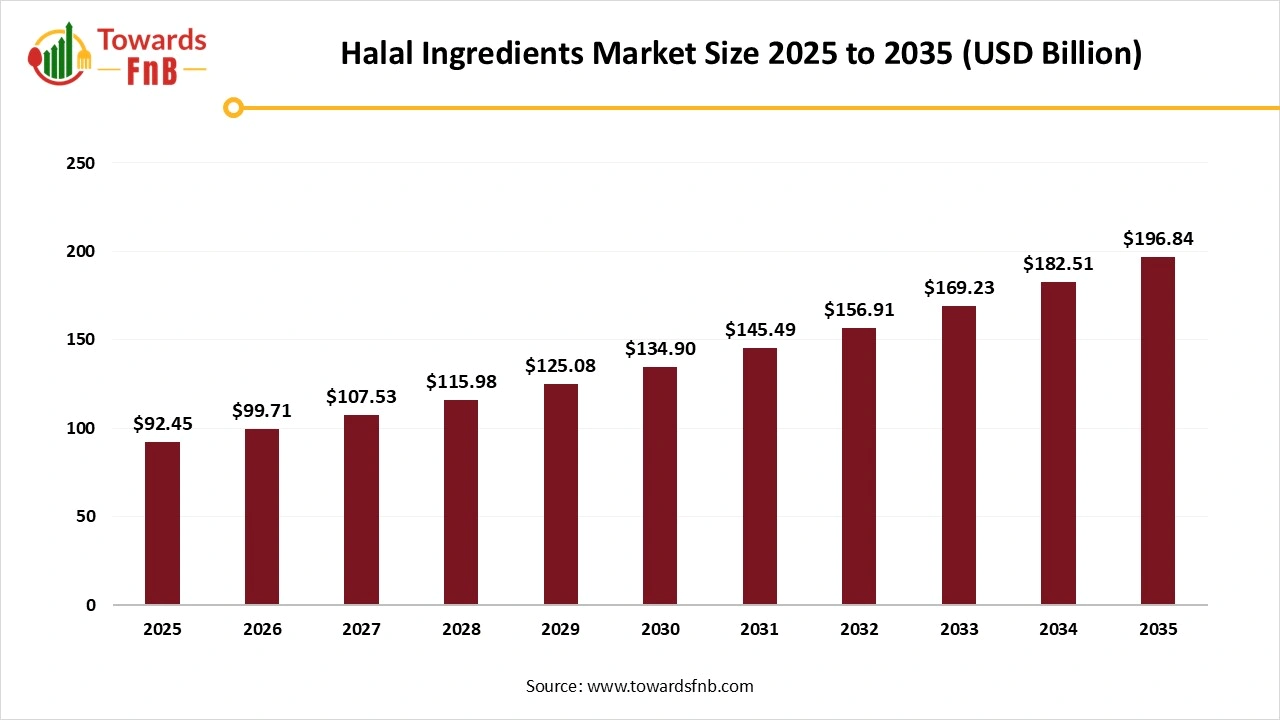
According to Towards Food and Beverages, the global halal ingredients market size is evaluated at USD 99.71 billion in 2026 and is projected to grow significantly, reaching USD 196.84 billion by 2035, registering a compound annual growth rate (CAGR) of 7.85% over the forecast period. This market is growing due to the increasing Muslim population and global awareness of clean-label products.
Ottawa, April 20, 2026 (GLOBE NEWSWIRE) — The global halal ingredients market size stood at USD 92.45 billion in 2025 and is predicted to grow from USD 99.71 billion in 2026 to approximately USD 196.84 billion by 2035, expanding at a CAGR of 7.85% from 2026 to 2035, as reported by Towards Food and Beverages, a sister firm of Precedence Research.
The growth trajectory is further supported by the expansion of halal-certified supply chains, advancements in food processing technologies, and increasing adoption of halal standards in pharmaceuticals, cosmetics, and personal care industries worldwide.
Note: This report is readily available for immediate delivery. We can review it with you in a meeting to ensure data reliability and quality for decision-making.
Access the Full Study Instantly | Download Sample Pages of the Report Now@ https://www.towardsfnb.com/download-sample/6098
Why is the Halal Ingredients Market Experiencing Rapid Growth?
The market for halal ingredients is expanding rapidly due to rising demand for halal-certified food, which is fueled by the growing number of Muslims worldwide and rising awareness of the need to consume safe, ethical and clean-label food. In addition to seeking religious compliance, consumers are also linking halal products to transparency, quality and hygiene, which is making them more appealing to non-Muslim consumers.
Further bolstering market expansion is the growth of food and beverages. The pharmaceutical and cosmetics sectors, as producers, use more halal-certified ingredients to appeal to a broader consumer base. With growing exports to Western nations and emerging markets in the Asia Pacific and the Middle East, the halal ingredients market is a rapidly developing and globally significant industry.
Case Study: Indonesia’s Halal Certification Expansion Driving Ingredient Demand
A powerful and recent example of how regulations are shaping the halal ingredients market is Indonesia’s nationwide halal certification expansion. As the world’s largest Muslim-majority country, Indonesia has been actively strengthening its halal ecosystem through mandatory certification policies under the Halal Product Assurance framework.
From 2024 onward, the government began extending halal certification beyond food into pharmaceuticals and medical devices, with phased implementation starting in 2026. This regulatory shift is forcing manufacturers to reassess their entire ingredient sourcing strategy from raw materials to processing aids.
As a result, companies operating in Indonesia are increasingly:
- Replacing conventional ingredients with halal-certified alternatives
- Shifting toward plant-based emulsifiers, gelatin substitutes, and excipients
- Investing in traceable and compliant supply chains
Why this matters for the market:
This transition is significantly increasing demand for certified halal ingredients across multiple industries, especially pharmaceuticals, which is already projected to grow at a strong pace globally.
Additionally, Indonesia’s move is influencing neighboring Southeast Asian markets and global exporters, who must now comply with stricter halal standards to maintain market access.
Halal Ingredients Market Key Takeaways:
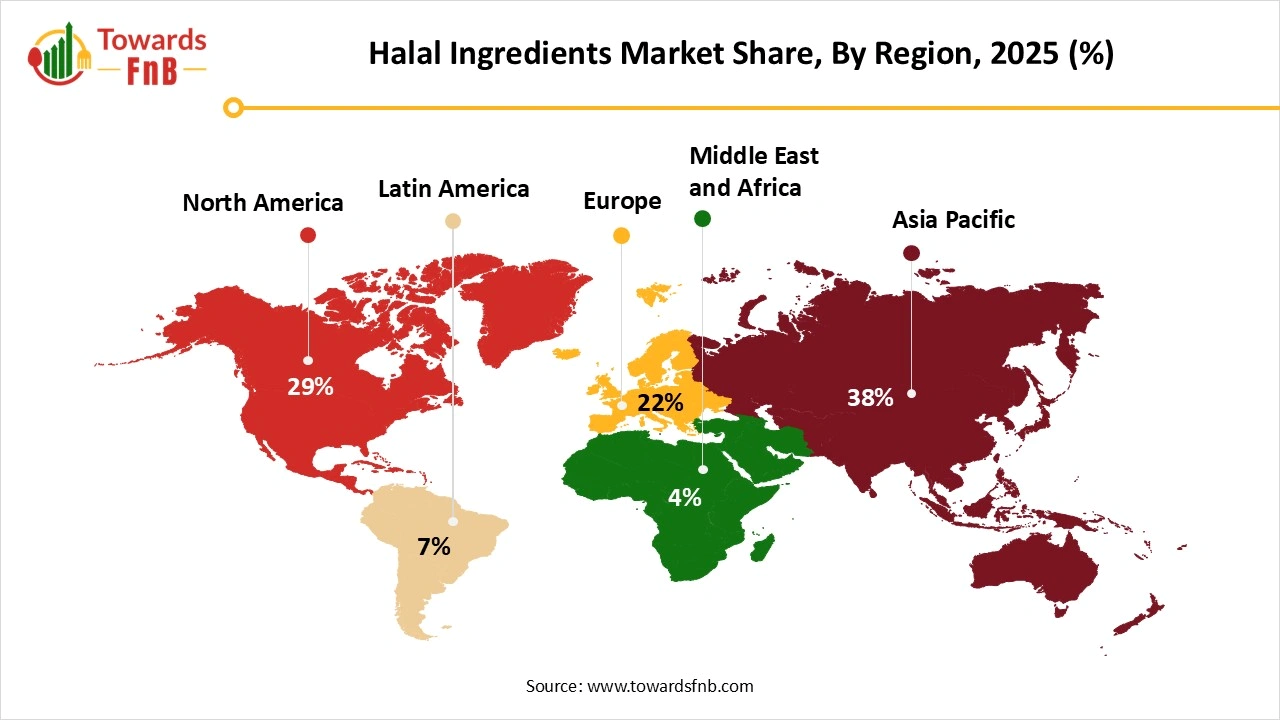
- Asia Pacific held the leading position in 2025 with a 38% market share and is anticipated to witness the fastest growth at a CAGR of 8.3%, while the Middle East & Africa followed with a 27% share.
- Among ingredient types, food ingredients dominated the market with a 52% share in 2025, whereas pharmaceutical ingredients accounted for 28% and are projected to grow at a CAGR of 8.4%.
- By source, plant-based ingredients led with a 46% share in 2025 and are expected to expand at the highest CAGR of 8.1%, followed by animal-based ingredients with a 34% share.
- In terms of application, the food & beverages segment held the largest share at 48% in 2025, while pharmaceuticals contributed 22% and are forecast to grow at a CAGR of 8.5%.
- Direct sales dominated distribution channels with a 55% share in 2025, whereas online platforms represented 12% and are expected to grow at a CAGR of 8.6%.
- By certification type, halal-certified products accounted for the largest share at 72% in 2025 and are projected to grow at a CAGR of 8.2%, while halal-compliant products held a 28% share.
Halal Ingredients Market Opportunities
- Expansion of plant-based and vegan halal ingredients to meet rising clean-label demand
- Growing demand for halal-certified food in non-Muslim markets driven by quality and safety perception
- Increasing use of halal ingredients in pharmaceuticals and cosmetics
- Development of functional and nutraceutical halal ingredients for health-conscious consumers
- Rising opportunities in emerging markets such as the Asia-Pacific and Africa
- Growth of halal-certified processed and convenience foods
- Adoption of digital traceability and certification platforms for supply chain transparency
- Expansion of B2B ingredient supply partnerships with global food manufacturers
Secondary Data: Halal Ingredients Market
| Category | Insights |
| Market Driver | Rising demand for halal-certified food and clean-label products |
| Consumer Base | 1.9+ billion Muslims + increasing non-Muslim preference for quality & hygiene |
| Key Industries | Food & Beverage (largest), Pharmaceuticals & Cosmetics (fastest growing) |
| Raw Material Trend | Shift toward plant-based and synthetic halal-certified ingredients. |
| Regional Leader | Asia-Pacific (high population + strong regulations) |
| Mature Markets | The Middle East has strict compliance requirements. |
| Emerging Regions | Europe & North America are driven by exports and awareness. |
| Key Trend | Clean-label, traceability, and ethical sourcing |
| Technology Adoption | Blockchain & digital tracking for halal verification |
| Key Challenge | Lack of global standardization in halal certification |
| Opportunity Area | Growth in vegan, halal, and functional ingredient innovation |
The market for halal ingredients is growing due to both religious demand and rising consumer preferences for products that are ethically sourced, transparent and safe. The market is dominated by food and beverages, but due to growing awareness of halal certified formulations, pharmaceuticals and cosmetics are emerging as high-growth segments. Asia Pacific leads the region because of its sizable consumer base, but North America and Europe are emerging as important growth regions.
Additionally, new market opportunities are being created by technological advancements and the rising demand for plant-based substitutes.
View Full Market Intelligence@ https://www.towardsfnb.com/insights/halal-ingredients-market
Recent Developments in the Halal Ingredients Market
- In February 2026, the Gulf Cooperation Council Standardization Organization (GSO) announced updated Halal food technical regulations. The new draft GSO 2055-1:2026 establishes Sharia-based standards across the entire food supply chain from production to service. These requirements mandate strict segregation from non-Halal products and Halal transport certification for high-risk animal goods.
- In October 2025, Halal Product Assurance Organizing Agency (BPJPH) announced mandatory halal certification for medical devices in Indonesia. Based on Government Regulation No. 42 of 2024, the certification will be launched in phases, starting with Risk Class A devices on 17 October 2026. Higher-risk categories follow in stages, with Class B in 2029, Class C in 2034, and Class D alongside biological products in 2039.
- In March 2026, Pinehurst announced the launch of Pinehurst Golf Club as a “Performance Playground” for modern business leaders. The reinvented concept integrates premium golf facilities with state-of-the-art business and networking environments to serve professional needs. This strategic rebranding aims to position the club as a primary hub for corporate engagement and high-level social interaction in Thailand.
Trade Analysis of Halal Ingredients: Import, Export, Production, and Manufacturing Data
- Halal Food Export Value (OIC countries): The total export value of halal food products (including ingredients) in OIC countries was approximately USD 163.6 billion in 2021. This covers a range of halal food products and ingredients exported across the globe.
- Halal Food Import Value (OIC countries): Imports of halal food products (including ingredients) in OIC countries reached about USD 232.6 billion in 2021. This includes a variety of halal-certified food items and ingredients sourced internationally.
- Turkey Halal Food Export Value: Turkey’s halal food exports, including ingredients such as halal-certified meats and processed food, were valued at around USD 3.2 billion in 2023. Turkey remains a significant player in halal food trade.
- Brazil Halal Meat Exports: Brazil’s halal meat exports, which also influence halal ingredients, were valued at approximately USD 2 billion in 2023, highlighting its role in supplying halal meat ingredients to global markets.
- Europe Halal Food Imports: Europe, a key market for halal products, imported EUR 12.5 billion worth of halal food products in 2022, which includes various halal food ingredients.
- Qatar Halal Food Imports: Qatar, as part of the Gulf region, imported around USD 4.5 billion in halal food products in 2023, showing high demand for halal ingredients.
- New Zealand Halal Exports: New Zealand, primarily known for its halal meat exports, contributed approximately USD 4.1 billion in halal product exports in 2023, which includes halal-certified ingredients in its supply chain.
- Production Orientation — Bangladesh (example): Bangladesh, particularly through companies like the Sajeeb Group, focuses on producing halal processed foods and ingredients for export, serving markets in the Middle East, Oceania, and South Asia. This includes a variety of ingredients like halal-certified rice, flour, and other processed products.
For Detailed Pricing and Tailored Market Report Options, Click Here: https://www.towardsfnb.com/checkout/6098
Halal Ingredients Market Report Scope
| Report Attribute | Key Statistics |
| Base Year | 2025 |
| Forecast Period | 2026 to 2035 |
| Growth Rate from 2026 to 2035 | CAGR of 7.85% |
| Market Size in 2026 | USD 99.71 Billion |
| Market Size in 2027 | USD 107.53 Billion |
| Market Size in 2030 | USD 134.90 Billion |
| Market Size by 2035 | USD 196.84 Billion |
| Dominated Region | Asia Pacific |
| Fastest Growing Region | North America |
| Regions Covered | North America, Europe, Asia-Pacific, Latin America and Middle East & Africa |
Feel Free to Get in Touch with Us for Orders or Any Questions at: sales@towardsfnb.com
Halal Ingredients Market Regional Analysis
Asia Pacific dominated with 38% market share in 2025 due to the large Muslim population and rising demand for goods with halal certification. Important contributors to regional development include nations like Indonesia, Malaysia and India. Growing public awareness and encouraging government programs are bolstering market growth. Product accessibility is being improved by the growth of e-commerce and organized retail. To meet both domestic and international demand, local manufacturers are progressively entering the halal market.
How big is the Asia Pacific halal ingredients market?
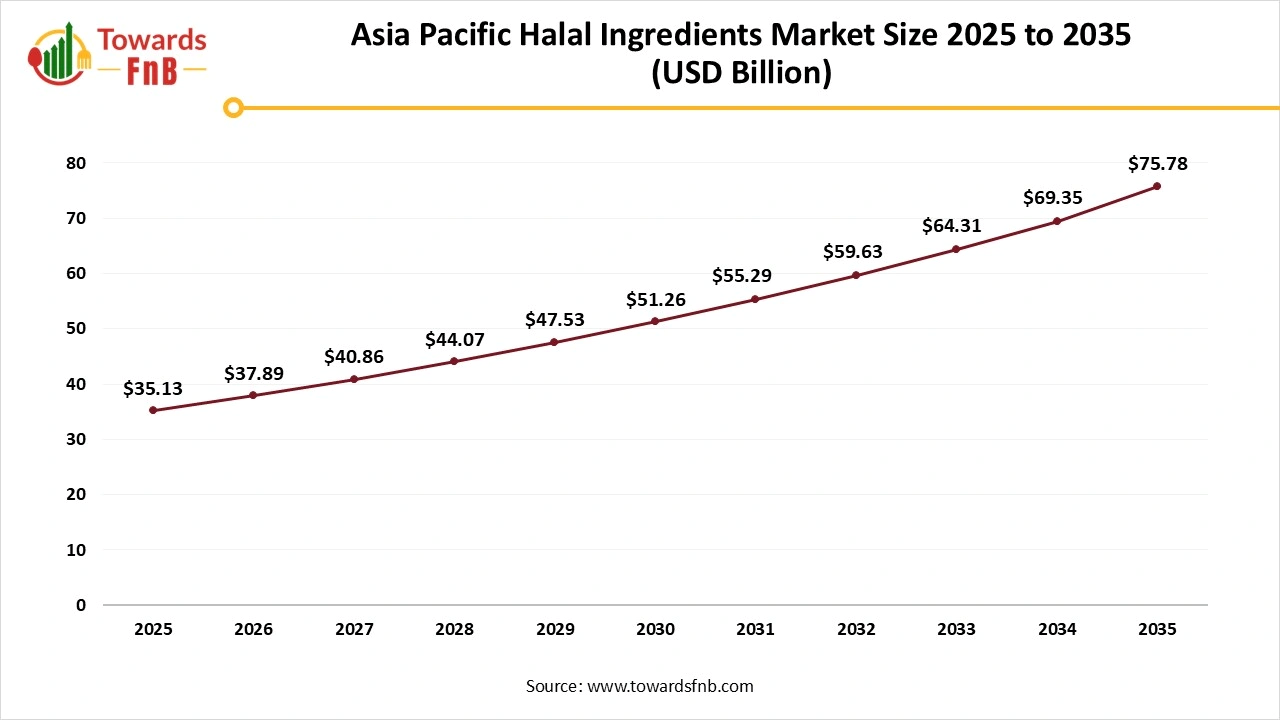
The Asia Pacific halal ingredients market size was valued at USD 35.13 billion in 2025 and is projected to reach approximately USD 75.78 billion by 2035, growing at a CAGR of 7.99% from 2026 to 2035.
The Middle East & Africa fastest growing, driven by a strong commitment to halal standards in both culture and religion. The market is being driven by rising investments in halal infrastructure and certification organizations. Regional growth is also being aided by rising export demand and tourism. Halal businesses are being promoted as important economic sectors by government-backed initiatives. Growing disposable incomes are also driving up demand for high-end halal goods.
Growth of Halal Ingredients Market in Latin America
The halal ingredients market in Latin America is witnessing notable growth, supported by a combination of demographic shifts, expanding export opportunities, and increasing awareness of halal-certified products. While the Muslim population in the region remains relatively small, countries such as Brazil and Argentina have emerged as major exporters of halal-certified food products, particularly meat and processed foods to Muslim-majority markets in the Middle East and Southeast Asia. This export-driven demand is encouraging food manufacturers to adopt halal-certified ingredients across their supply chains, including additives, flavorings, emulsifiers, and preservatives. At the same time, halal ingredients are gaining broader appeal among non-Muslim consumers due to their association with strict quality control, hygiene standards, and ethical sourcing. The growth of the processed food and beverage sector, along with increasing urbanization and changing dietary patterns, is further driving demand for certified and traceable ingredients.
Have Questions? Let’s Talk—Schedule a Meeting with Our Insights Team: https://www.towardsfnb.com/schedule-meeting
Halal Ingredients Market Segmental Analysis
Ingredient Type Analysis
The food ingredients segment dominated the market with 52% market share due to the extensive usage of halal ingredients in processed and packaged food. This market is being driven further by growing consumer demand for clean labels and ethically sourced goods. To meet the demands of international markets, food manufacturers are increasingly using halal-certified ingredients. The segment is expanding due to the rising demand for convenience and ready-to-eat food. Product quality and shelf life are being improved by ongoing innovation in food processing technologies.
The pharmaceutical ingredients segment is growing rapidly with 8.4% CAGR, driven by the rising demand for pharmaceuticals and medical supplies with halal certification. Customers are growing increasingly aware of where pharmaceutical ingredients come from. Additionally, regulatory agencies are encouraging drug manufacturers to adhere to halal standards. Product development in halal pharmaceutical R&D is accelerated by growing investments. International pharmaceutical firms are expanding into halal markets to fill unmet demand.
Source Analysis
The plant-based segment dominated the market with 6% market share, because of its organic origin and simple halal compliance. Growing vegetarianism and veganism are contributing to the segment’s expansion. Manufacturers are focusing on plant-based alternatives to meet halal standards. Adoption is improved by a lower risk of contamination when compared to sources derived from animals. Applications are growing as plant-based formulations become more innovative.
The food and beverage segment is growing rapidly, with 34% market share driven by a rise in the consumption of processed food and beverages with halal certification. Demand is rising due to shifting eating habits and increased urbanization to take advantage of this, expanding businesses are diversifying their halal product offerings. Additionally, there is a growing market for functional and fortified halal food. A wider range of consumers is being drawn in by product diversification and innovative flavors.
Application Analysis
The food and beverage segment dominated the 48% market share because halal-certified food products are consumed in large quantities worldwide. Growth is further accelerated by the rising demand for convenience food. This market is supported by robust distribution networks and product availability. Growing halal food exports are helping to boost income. Market presence is being strengthened through ongoing product launches and branding initiatives.
The pharmaceutical segment is growing rapidly with 8.5% CAGR because there is a growing need for halal-compliant medical services. Adoption is being driven by increased knowledge about medications and supplements with halal certifications. To increase their market share, pharmaceutical companies are spending money on halal certification. The need for safe and compliant medications is rising as chronic diseases become more common. Pharhalal-compliant certification organizations are working together to support market expansion.
Distribution Channel Analysis
The direct sales segment dominated the market with 55% market share. Long-term supply agreements and bulk purchases are best served through direct sales channels. Suppliers and manufacturers keep close ties with retailers and distributors. This channel guarantees improved product authenticity and pricing control/ timely delivery, and effective supply chain management are also made possible by it. For cost saving and quality control, large-scale purchasers favor direct procurement.
The online platforms segment is growing rapidly with an 8.6% CAGR, propelling the growth of halal products on the internet. Online shopping is preferred by customers because it is convenient and offers a wider selection of products. This market is being further boosted by digital marketing and accessibility. Online shopping is increasing as smartphone adoption rises. Global access to halal-certified products is made possible by cross-border e-commerce.
Certification Type Analysis
The halal-certified segment dominated the market with 72% share in 2025, because of stringent adherence to halal regulations. For authenticity and quality control, consumers value certified labels. This dominance is reinforced by international trade regulations and frameworks. Certification boosts consumer confidence and brand credibility. To foreign markets, export-focused businesses are depending more on certification.
The halal-compliant segment held the second-largest share of 8% in 2025 because of cheaper certification fees. These goods may not have official certification, but they do satisfy the fundamental halal standards. Demand for fully certified products is anticipated to gradually shift as awareness grows. Due to its cost-effectiveness, small and medium-sized businesses frequently favor this market. Long-term growth, however, might be hampered by low consumer trust in comparison to certified products.
Feel Free to Get in Touch with Us for Orders or Any Questions at: sales@towardsfnb.com
Additional Topics Worth Exploring:
- Low-Calorie RTD Beverages Market: The global low-calorie RTD beverages market size is forecasted to expand from USD 30.49 billion in 2026 to reach around USD 50.65 billion by 2035, growing at a CAGR of 5.8% during the forecast period from 2026 to 2035.
- Soybean Seed Market: The global soybean seed market size is forecasted to expand from USD 12.24 billion in 2026 to hit around USD 22.89 billion by 2035, growing at a CAGR of 7.2% during the forecast period from 2026 to 2035.
- Canola Meal Market: The global canola meal market size is forecasted to expand from USD 21.35 billion in 2026 to hit around USD 29.23 billion by 2035, growing at a CAGR of 3.55% during the forecast period from 2026 to 2035.
- Oat Milk Market: The global oat milk market size is forecasted to expand from USD 4.82 billion in 2026 to reach around USD 19.67 billion by 2035, growing at a CAGR of 16.92% during the forecast period from 2026 to 2035.
- Energy Bar Market: The global energy bar market size is forecasted to expand from USD 7.51 billion in 2026 to hit around USD 14.45 billion by 2035, growing at a CAGR of 7.55% during the forecast period from 2026 to 2035.
- Meal Kit Delivery Services Market: The global meal kit delivery services market size is forecasted to expand from USD 42.88 billion in 2026 to hit around USD 89.35 billion by 2035, expanding at a CAGR of 8.5% during the forecast period from 2026 to 2035.
- Powdered Fats Market: The global powdered fats market size is forecasted to expand from USD 27.16 billion in 2026 to reach around USD 40.78 billion by 2035, growing at a CAGR of 4.62% during the forecast period from 2026 to 2035.
- Meat Processing Equipment Market: The global meat processing equipment market size is forecasted to expand from USD 13.81 billion in 2026 to reach around USD 25.23 billion by 2035, growing at a CAGR of 6.92% during the forecast period from 2026 to 2035.
- Insoluble Dietary Fibers Market: The global insoluble dietary fibers market size is forecasted to expand from USD 4.15 billion in 2026 to reach around USD 8.45 billion by 2035, growing at a CAGR of 8.2% during the forecast period from 2026 to 2035.
- Meat Products Market: The global meat products market size is forecasted to expand from USD 1.89 trillion in 2026 to hit around USD 2.85 trillion by 2035, growing at a CAGR of 4.65% during the forecast period from 2026 to 2035.
Key Companies and Their Role in the Halal Ingredients Market
- Barentz B.V.
Barentz B.V. is a global specialty ingredients solution provider headquartered in Amsterdam, Netherlands. Founded in 1953, the company operates in more than 70 countries and serves industries such as pharmaceuticals, personal care, and food & nutrition. It focuses on sourcing and distributing high-quality ingredients while offering formulation and technical support services.
Role in Halal Market: Barentz strengthens halal supply chains by distributing certified ingredients and enabling manufacturers to meet regulatory and quality standards globally.
- PureCircle Ltd.
PureCircle Ltd. is a leading producer of plant-based sweeteners, particularly stevia-derived ingredients used in food and beverages. The company focuses on natural, zero-calorie sweetening solutions aligned with clean-label and halal requirements.
Role in Halal Market: It supports the growing demand for halal-certified, natural, and healthier food ingredients, especially in beverages and processed foods.
- Symrise AG
Symrise AG is a Germany-based global manufacturer of flavors, fragrances, and cosmetic ingredients, with operations in over 100 locations worldwide and a portfolio of around 35,000 products.
Role in Halal Market: Symrise develops halal-compliant flavoring and fragrance ingredients, helping food, beverage, and cosmetic companies cater to Muslim consumers worldwide.
- Halagel (M) Sdn. Bhd.
Halagel is a Malaysia-based company specializing in halal-certified gelatin and hydrocolloids used in food, pharmaceuticals, and cosmetics.
Role in Halal Market: It plays a niche but critical role by supplying fully halal-certified gelatin alternatives, which are essential for strict compliance in Islamic dietary laws.
- Ashland Inc.
Ashland is a global specialty chemicals and ingredients company serving industries such as pharmaceuticals, food & beverages, and personal care. It operates in more than 100 countries and focuses on innovation-driven ingredient solutions.
Role in Halal Market: Ashland provides specialty ingredients and excipients that can be adapted to halal-certified formulations, supporting manufacturers in regulated markets.
Segments Covered in the Report
By Ingredient Type
- Food Ingredients
- Emulsifiers
- Lecithin
- Mono & Diglycerides
- Flavors & Enhancers
- Natural Flavors
- Artificial Flavors
- Sweeteners
- Natural Sweeteners
- Artificial Sweeteners
- Preservatives
- Natural Preservatives
- Synthetic Preservatives
- Emulsifiers
- Pharmaceutical Ingredients
- Active Pharmaceutical Ingredients (APIs)
- Excipients
- Cosmetic Ingredients
- Surfactants
- Emollients
- Colorants
By Source
- Plant-Based
- Fruits & Vegetables
- Grains & Cereals
- Oilseeds & Pulses
- Animal-Based
- Meat Derivatives
- Dairy Derivatives
- Gelatin & Collagen
- Synthetic
- Chemical-based Ingredients
- Lab-derived Compounds
By Application
- Food & Beverages
- Bakery & Confectionery
- Dairy Products
- Processed Foods
- Beverages
- Pharmaceuticals
- OTC Drugs
- Prescription Drugs
- Cosmetics & Personal Care
- Skincare
- Haircare
- Oral Care
- Nutraceuticals
- Dietary Supplements
- Functional Foods
By Distribution Channel
- Direct Sales (B2B)
- Distributors & Wholesalers
- Online Platforms
- Specialty Stores
By Certification Type
- Halal Certified
- Government Certification Bodies
- Private Certification Bodies
- Halal Compliant (Non-certified)
By Region
North America
- U.S.
- Canada
Asia Pacific
- China
- Japan
- India
- South Korea
- Thailand
Europe
- Germany
- UK
- France
- Italy
- Spain
- Sweden
- Denmark
- Norway
Latin America
- Brazil
- Mexico
- Argentina
Middle East and Africa (MEA)
- South Africa
- UAE
- Saudi Arabia
- Kuwait
Thank you for exploring our insights. For more targeted information, customized chapter-wise sections and region-specific editions such as North America, Europe, or Asia Pacific, are also available upon request.
For Detailed Pricing and Tailored Market Report Options, Click Here: https://www.towardsfnb.com/checkout/6098
Feel Free to Get in Touch with Us for Orders or Any Questions at: sales@towardsfnb.com
Unlock expert insights, custom research, and premium support with the Towards FnB Annual Membership. For USD 495/month (billed annually), get full access to exclusive F&B market data and personalized guidance. It’s your strategic edge in the food and beverage industry: https://www.towardsfnb.com/get-an-annual-membership
About Us
Towards Food and Beverages is a global consulting firm specializing in the food and beverage industry, providing innovative solutions and expert guidance to elevate businesses. With an in-depth understanding of the dynamic F&B sector, we deliver customized market analysis and strategic insights. Our team of seasoned professionals is committed to empowering clients with the knowledge needed to make informed decisions, ensuring they stay ahead of market trends. Partner with us as we redefine success in the rapidly evolving food and beverage landscape, and together, we’ll navigate this transformative journey.
Web: https://www.towardsfnb.com/
Our Trusted Data Partners
Precedence Research | Statifacts | Towards Packaging | Towards Chemical and Materials| Nova One Advisor | Food Beverage Strategies | FnB Market Pulse
For Latest Update Follow Us:
LinkedIn | Medium| Twitter
Discover More Market Trends and Insights from Towards FnB:
➡️Beverage Flavors Market: https://www.towardsfnb.com/insights/beverage-flavors-market
➡️Salt Market: https://www.towardsfnb.com/insights/salt-market
➡️Probiotic Food Market: https://www.towardsfnb.com/insights/probiotic-food-market
➡️Protein Bar Market: https://www.towardsfnb.com/insights/protein-bar-market
➡️Gluten-Free Bakery Market: https://www.towardsfnb.com/insights/gluten-free-bakery-market
➡️Europe Nutraceuticals Market: https://www.towardsfnb.com/insights/europe-nutraceuticals-market
➡️Canned Food Market: https://www.towardsfnb.com/insights/canned-food-market
➡️Dry Fruit Market: https://www.towardsfnb.com/insights/dry-fruit-market
➡️Frozen Meat Market: https://www.towardsfnb.com/insights/frozen-meat-market
➡️Fish Oil Market: https://www.towardsfnb.com/insights/fish-oil-market
➡️Soft Drink Concentrates Market: https://www.towardsfnb.com/insights/soft-drink-concentrates-market
➡️Meal Kits Market: https://www.towardsfnb.com/insights/meal-kits-market
➡️Ethnic Food Market: https://www.towardsfnb.com/insights/ethnic-food-market
 Disclaimer: The above press release comes to you under an arrangement with GlobeNewswire. IndiaEveningPost.com takes no editorial responsibility for the same.